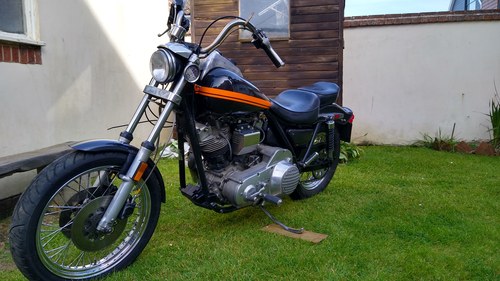

Description
SOLD ?
1982 HARLEY SHOVELHEAD FXR
RARE MODEL ONLY MADE 1980 TO 1983
THE BEST OF THE SHOVELS.... 5 SPEED .... RUBBERMOUNT...
THIS MODEL WAS THE TRANSITION BETWEEN THE FIRST EVO AND THE END OF THE SHOVELHEAD ERA.
ELIGIBLE FOR HISTORIC TAX
JUST HAD REBORE AND NEW PISTONS (not yet run in)
MATCHING NUMBERS
MIKUNI HS40
TWIN PLUG HEADS
REVTECH SINGLE FIRE IGNITION
TWIN DYNA COILS
NEW CLUTCH PLATES (big bearing clutch)
ISOLATED PRIMARY (uses ATF)
HISTORY FILE
THIS BIKE WAS BOUGHT FROM RIVERSIDE M/ Cs PUTNEY IN 1994 BY A FRIEND WHO CAN NO LONGER RIDE.(logbook in his name)
IT HAD BEEN DRY STORED FOR A NUMBER OF YEARS.
BELIEVE SPEEDO CHANGED IN EARLY 2000s (so true milage is probably around 45k)
IT WAS RECOMMISIONED AND SERVICED WITH NEW OIL, FILTERS AND BRAKE FLUID OVER THE WINTER.
NO PX
BALANCE BY CLEARED DIRECT BANK TRANSFER BEFORE COLLECTION.
IT IS RUNNING WELL BUT IT IS A 40YR OLD MOTORCYCLE SO IS SOLD AS SEEN . The FXR is considered one of the best Harleys on the road, but this wasn’t always the case. In fact, when it was first launched in 1982, people seemed to consider it too Japanese. To die-hard Harley fans, it felt too much like riding a Honda or a Yamaha. The fact was that the FXR was designed to challenge the foreign bikes that were slowly gaining a significant market share.
The foreign bikes were sportier, rode better, and offered better ride comfort. In comparison, most Harleys were rumbling beasts that would carry on for miles but didn’t offer similarly efficient handling.
The FXR changed that. It offered a better, steady riding experience and delivered great handling. It was a better bike but riding it wasn’t a quintessential Harley experience. This was Harley looking towards the future and evolving. Overall, the FXR was their first step towards delivering better bikes.
The History of the FXR
Before the FXR came out, the Harleys were good looking. But they also tried their best to jostle you out of your seat. The aim of the FXR was to combine the looks and performance of the Harley V-Twin without compromising its handling.
That’s one of the reasons why this Harley is often considered the engineer’s bike. The company was working on the FLT when they realized that they needed to design a bike for the newer audience. However, they didn’t really have the money or the time to start building the FXR from scratch. Their only option was to build the bike with a new frame and the same drive train as the FLT.
They already knew what their goal was. They wanted a sportier bike that would attract people that had stayed away from traditional Harleys. Of course, sportier bikes by Harley’s definition were slightly different than the normal sports bikes. You could call FXRs cruisers. They’re meant to offer comfortable rides across long distances.
The Design Team
There is no doubt about the fact that the FXR is considered an engineer’s bike. This is because the design team was very adamant about creating a bike with a more universal appeal. This took the company in a very different direction. Before the FXR, the designers clung to the traditional chassis and drive train combination because that’s what they had always known. It was their signature, after all. The designers wanted to incorporate all that they loved about foreign bikes but still maintain the quintessential Harley feel.
The people behind this vision were the Team FXR. The team was lead by Steve Pertsch and included Bill Brown, Rit Booth, Erik Buell, Bob LeRoy, and several others.
There were several stops and starts before they could get a fix on the design. There was a potent influence of a very young and enthusiastic design team involved in the design process. Eric Buell was actually a road racer. Needless to say, he and his team mates knew just what they wanted from the bike.
The Early Bikes
The first of the FXRs were released in 1981 and were called the ’82 models. There were two bikes that were released:
FXR Super Glide II had laced wheels
FXRS with a two-tone paint and cast wheels
Realizing the potential of the FXR, they immediately started to build on the platform. In the years that followed
The Engineering on the FXR
We’ve stated repeatedly that the FXR is a sportier model, that’s primarily because of its frame. Take a look at how it was engineered:
This new frame was stiff and solid, with plenty of ground clearance, and gorgeous lean angles.
Riders especially appreciated the ground clearance when they took fast turns. The frame was triangular with welded stamped-steel parts.
Most of these Harleys were hand assembled which really amped up the price-tag on these wheels.
The first bikes came with a 3. 8 gallon Fat Bob tank with the fuel cap and gauge incorporated into the console.
The battery and the oil tank were underneath the superbly comfortable seat. The bikes also had triple disk brakes on their Dunlop tires.
In all, the complete package was meant for maneuverability and easier handling. The bike was more compact than the Big Twins but offers a better riding experience.
The 80ci Shovelhead engine was rubber mounted and had five-speed transmission. The rear shock-absorbers were set back in the swingarm to balance the bike out.
Even though the FXR is no longer in production, it’s still one of the most loved Harleys. Collectors and Harley enthusiasts scour the market to get their hands on FXRs. Needless to say, the bike has attained a die-hard following