Description
THE INTERIOR
This car comes equipped with the classic blood red vinyl interior, trimmed with high quality wood and stainless steel brightwork. From the almost ornamental black wheel to the beautiful, clearly designed dials and switchgear, every inch of the car’s cabin has been well thought through and is in superb condition. The clocks and switchgear have some light patina, hinting at the car’s age, but otherwise you’d be forgiven this had recently rolled off the production line. It’s been kept in strikingly good condition. A couple of real highlights are the knurled stainless elements that run across the dash fascia and the original radio – a rare thing indeed.
The owner has had bespoke, black and red, 1960s style ‘Cocomats’ fitted (ordered direct from the manufacturer in the USA). Woven from coconut fibres, they are an elegant and period correct detail that really lifts the cabin. In fact, they were a factory option at the time of the 230SL’s production.
Behind the front seats, the generous luggage area is carpeted in deep red to match the cabin carpets. The boot is very large – easily big enough for a couple of large suitcases with room to spare. Lined with good quality black carpet, the original rubber boot liner is underneath and, beneath that, the floor of the car is in immaculate condition. The boot also contains a full-size spare wheel with black vinyl cover, the original tool kit and a more modern Mercedes branded toolkit.
The door shuts and hinge areas are pristine, all of the switchgear, the door handles, locks and windows operate very nicely and overall the car is presented in a condition very close to concours. The only issue we could find was a missing clip on the driver’s side sun visor.
THE EXTERIOR
Of course, it’s the exterior that really stands the 230SL apart from the crowd. Based on a shortened and strengthened version of the 220SE saloon floorpan, it’s a thing of remarkable beauty. Smaller than you may think, but beautifully proportioned and elegantly detailed. It was also the first global sports car to be produced with a rigid passenger cell featuring front and rear crumple zones. This was a very advanced car for the time, even the bonnet, boot lid, door skins and tonneau cover were made of aluminium to reduce weight.
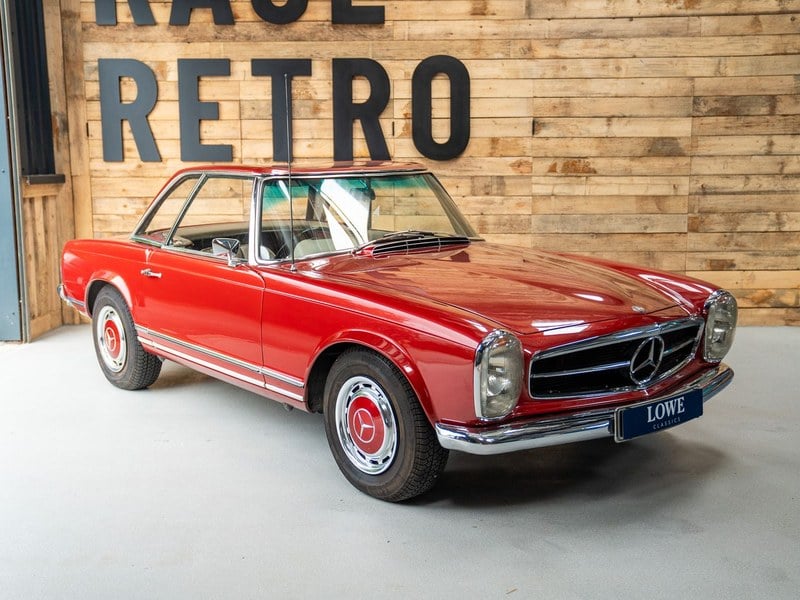
This car is presented in truly wonderful condition externally. The characteristic upright Bosch "fishbowl" headlights are perfect and stand either side of a wide, chrome grille and three-pointed star in near factory condition. In fact, all of the external brightwork looks brand new, and the paintwork itself has the kind of deep, glossy shine and mirror-like finish that tells the story of just how well this car has been looked after. The paintwork is in immaculate condition.
That iconic “Pagoda” removable hardtop is present and correct. It is in great condition. Underneath the rear tonneau, the car features a black fabric hood. As with all Pagodas, it’s a tight fit, but it’s in fantastic condition and operates well.
Mercedes’ classic 14-inch hubs are resplendent in black and chrome, and shod in new 205/ 70/ R14 Michelin MXT tyres. Underneath the car is in great condition, very tidy and with no evidence of corrosion or grounding out.
THE MECHANICS
Power comes from the M127 engine, a derivation of Mercedes’ M180 engine, but with Bosch multi-port fuel injection, more displacement, a higher compression ratio and a raft of complementary upgrades. In the 230SL it offers the driver a healthy 148bhp and 145 lb-ft from the sonorous 2. 3-litre straight-six. Here, it sounds in great condition. It revs smoothly and idles well, with no evidence of smoking or any fluid leaks. The engine bay itself looks almost pristine and gives evidence of the care given to the vehicle.
The car’s drivetrain consists of a manual 4-speed transmission, double wishbone front suspension and a swing rear-axle with front disc-brakes and rear drums. All of the car’s mechanical aspects are in fine condition, and in driving conditions the car runs well, with no knocks, creaks or noise from the suspension or brakes. You’d be forgiven for thinking you were in a far more modern car.
Perhaps this should be no surprise. As mentioned previously, the car underwent a significant restoration in Sweden and, as evidenced by the photographic record, as much work clearly went into the mechanical aspects of the car as went into the body and cabin.
THE APPEAL
Not many words stir the blood of petrolheads and collectors alike, but “Pagoda” is one of them. The W13 has become synonymous with quality, style and, that rarest of things, cool. It’s the kind of car you imagine Marilyn Monroe, Dean Martin and Paul Newman would have loved. Proper, old school Hollywood luxury and style, with a dash of rogue-ish performance.
And it’s that cache that makes it so sought-after and desirable all these years later. Adored by collectors and driving enthusiasts, it remains one of the prettiest cars ever built. HISTORY
Mercedes’ 230SL arrived in 1963 and remained in production for just 4 years until 1967, when it was replaced by the 250SL.
This car, a left-hand-drive European model, was comprehensively restored in Sweden before I purchased it in 2013. A photographic record of the restoration comes with the car, showing just how significant it was.
Having been kept covered, stored in a heated garage and only driven in fine weather, this really is a sublime example of a W113, presented in an excellent specification with the desirable 4-speed manual transmission.
Beloved by me, i am only parting with it as an upcoming house move means i will no longer have the room to store the car.
THE PAPERWORK
As the car was restored and imported from Sweden in 2013, much of the early documentation for the car is not available. However, the car does come with a detailed photographic record of the rebuild, along with a number of receipts, invoices and paper records from its time in mainland Europe.
Present and correct is a set of original handbooks and a service booklet, the current V5 (confirming the car’s first registration in the UK in 2013), the import documentation and the numberplate authorisation certificate from the DVLA.